Print Screen

Print has long fascinated me. Probably because I’ve spent so much of my lifetime in front of, or otherwise interacting with, a screen of some kind, there’s a level of respite to be found in the printed page. Also helps that I studied graphic design, and with it became familiar with all sorts of print. And I worked in a print shop for a little while, too!

For years I’ve wanted to redesign this blog, top-to-bottom – but two things have kind of got in the way. The first is that I’ve never really known what I want it to look like. 2000s-era web design is all well and nostalgic, and certainly would fit the era I typically hover around… but let’s face it. It looked tacky then, and it looks tacky now. I never thought much of the shiny, lickable Web 2.0 guff even then. You can do it tastefully, but I still don’t see that it’s very me, yaknow?

The other reason is that I hate themeing for WordPress. Been down that road, it’s full of thorny bramble and there’s broken glass all over the floor and the buildings are all on fire. (Basically, it’s a pfaff to get your head round and it never works anyway.) I think through a combination of things, including discovering the delightful typeface Junicode, finding (and buying many of) the special United States of Letterpress books from Field Notes, and running into the excellent (if rather opinionated) Practical Typography online book; I’ve come to realise what I want my blog to look like. For now, anyway…!

I also came across the lovely Flexoki colour scheme by Steph Ango (also known for the app Obsidian) and have thought for a long time that I wanted to use it for something. Turns out a printerly-ish website is the perfect candidate! In terms of software, I quite liked the idea of static site generators, and I think I’ve found the one I’d like to use: kiki, a shareware (!) construction set that fits on a floppy disk.

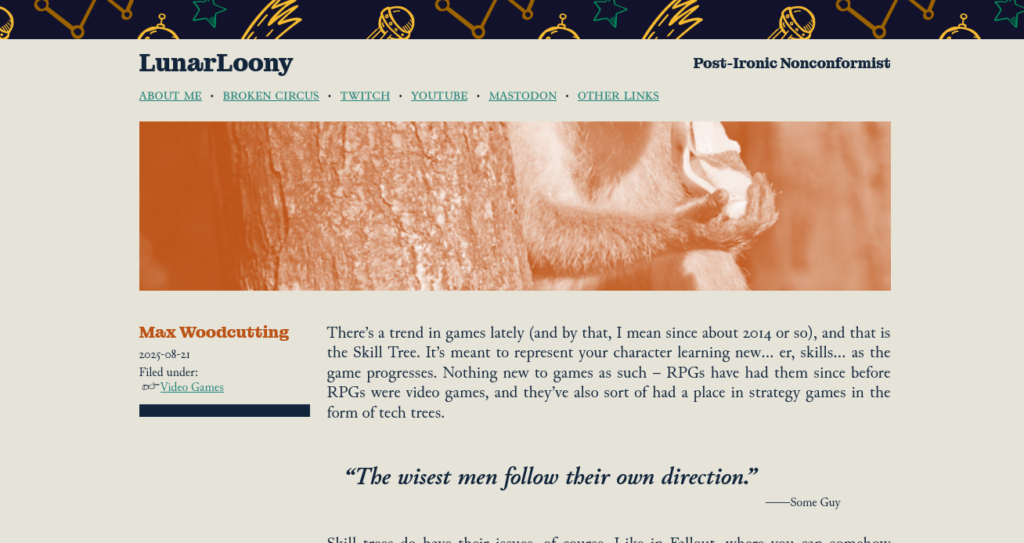
Further thoughts to transpire when I actually build the thing, but for now, enjoy this preview. (Click it to explore! Most of the links don’t work, but give it a go anyway.)

Max Woodcutting

There’s a trend in games lately (and by that, I mean since about 2014 or so), and that is the Skill Tree.

It’s meant to represent your character learning new… er, skills… as the game progresses. Nothing new to games as such – RPGs have had them since before RPGs were video games, and they’ve also sort of had a place in strategy games in the form of tech trees. Skill trees do have their issues, of course. Like in Fallout, where you can somehow become more skilled in Big Guns despite never holding a rocket launcher in your life.

What I’m referring to specifically is the modern “Action Game With RPG Elements” – those RPG elements typically being a Skill Tree. Lots of games have ’em, from the varied trees in Payday 2 to the relatively benign levelling system in Donkey Kong Bananza.

Thing is, if you go back and play Donkey Kong 64, you’ll note that there are no skill trees. But there are still skills! Instead of going to a menu and nebulously purchasing a skill whenever you want, you have to go and visit Cranky or Funky or someone else and get the skills from them. This makes a lot more sense in the context of the game, and more than that, I think it’s more fun and immersive when you’re not kicked out to a menu every time. It feels more like you’re playing as the character, not managing them.

Anyway, all this still doesn’t answer the biggest question about skill trees… what happens to your skills between games??

Material Wealth

I’ve always been pretty good at getting attached to objects, and I’ve always been pretty bad at letting go in general.

I remember a lot of instances where, as a child, I was asked if I wanted something (to which I would often say ‘yes!’); or if I wanted to get rid of something (to which I would invariably respond ‘no!’). It sometimes got a little out-of-hand, like when my dad sold my PlayStation on eBay, and I used his email account to contact the buyer and ask them to give it back.

…Is it a rule that you have to bear your soul during Blaugust? Seems to be happening a lot around here… anyway…

Over the years, this has been less and less a problem; because while I’m still very good at getting attached to Objects, I can’t very well get attached to an Object that I don’t have in the first place. However, lately (since first moving out, in fact), I’ve been finding myself trying to make more sustainable choices. Buying less plastic, getting clothes and furniture that’ll last me, buying second-hand, and shopping local where possible.

Unfortunately, my beautiful solarpunk vision is held back somewhat because, well, it’s often the expensive choice. I’m still reeling at the fact I spent around £700 on a Fairphone, for instance. It also doesn’t help that I’m from Yorkshire, where it’s traditional to be tight with your cash, and that I also grew up in a low-income environment. (If you’re aware of Sam Vimes’ boots theory of socioeconomic unfairness, feel free to insert it here.) So, when I’m able to get a good deal on a item that I know is going to last me, it feels particularly nice.

A few years ago, I came across a second-hand clothes shop in Whitby. I didn’t really take in much of what was going on, because all along the back wall, they had shelf after shelf of Levi jeans in every possible size, colour, and configuration. Are Levis the best jeans? I don’t know. My dad would say Wranglers. All I know is that during my graphic design days, everyone wore ’em and swore by ’em, and there must be a reason this shop specialised in them. That day, I ended up picking out a pair of Levi 512s, and they were one of the absolute best clothing items I’ve ever bought! Dark blue and comfy as all heck.

I only say ‘were’ because I’ve since bought another pair, which are even better because they have bigger pockets. And the thing about this other pair, is that they were my favourite kind of bargain. Ultra-cheap price, factory seconds (which, odd as it is, I have a bit of a soft spot for), brand new, and exactly right in every possible sense. …except the colour isn’t quite as good.

Hey, if I’m gonna get attached to something, why not something that’ll hopefully stick around a while?

More Adventures in Unsolvable Mysteries

The idea of an unsolved, or unsolvable mystery, is something I find endlessly fascinating… but you can read my previous blog post if you wanna catch up on that: The Bittersweet Disappointment of a Solved Mystery Since writing that, I’ve thought of a few other of these tantalising tidbits.

  • Crash TwinSanity. Not really an unsolved mystery as such, more a bit of a cautionary tale. TwinSanity has a lot of problems, the main one being that it barely feels like a Crash Bandicoot game, and I seem to recall not being super impressed about it at the time. Despite all this, I actually genuinely love it to bits, and the main reason is that there was probably more material on the cutting room floor than ended up on the final disc. It’s pretty tragic, because it was the first proper effort to explore Crash’s lore… and it gave us a rendition of Neo Cortex that is as yet unparalleled.
  • Speaking of Crash, there are a lot of loose threads in the original trilogy which never get resolved. Probably because they made the bone-headed decision of introducing time travel, which – hot take – kinda ruined the third game. Still, there’s a lot of stuff happening in the background of the first game that you never hear about – like why is there so much abandoned infrastructure? Who built those infamous bridges?
  • The Publius Enigma. Yes, I do know about things that aren’t video games, who knew?? This was a very infamous legend in rock music – it centres around Pink Floyd, who supposedly left lots of cheeky little clues in their album covers. People specifically refer to The Division Bell as having some sort of secret behind the cover… except there are enough variants of that cover that it can’t possibly be solvable. ANYWAY, I don’t think there was ever a proper conclusion to the Publius Enigma; and as with anything involving UK rock acts, it was probably just the band playing with their fans. (See also: The Beatles.)
  • There was something about Rush, but I can’t remember what it was now.
  • Apparently, the song ‘Carouselambra’ by Led Zeppelin is supposed to be the second of a three-part series; the first being ‘Stairway to Heaven’. I don’t have a single fact to back that up, but it’s interesting to speculate what the greater plan is there. Again, Robert Plant’s probably just messin’ with us.
  • Lifehouse! Or Life House, maybe? The magnum opus of Pete Townshend (of The Who fame), which never really saw the light of day. It was supposed to be a concept album, but with a huge, unattainable scope. (I’m pretty sure there was a movie mentioned, as well as something mad like a four-disc set at a time when two discs were rare. Or I’m just making things up again.) Remnants of the album can be found on Who’s Next… so if you’ve ever listened to ‘Baba O’Riley’ or ‘Pure and Easy’, have a think how those two songs might have linked together!
  • Last one, for now. Many of Stuart Ashen’s older videos had oddities, usually tacked onto the end, and which have sadly died a death in recent years. (By ‘recent’, I mean since about 2012 or so. Yes. So recent.) They were the sort of thing that – knowing Stuart – probably didn’t have much deeper meaning… but by golly, were they intoxicatingly weird! Like the one fuzzy clip of someone working in a lab, with a numbers station playing in the background… or that one video with the four names.

That’s all for now. I just enjoy things like this, alright?

Demo Discs were Pretty Rad

I didn’t get a huge amount of games growing up. We always had systems that were at least one generation older than everyone else had – so while most people spent the early 2000s with their brand-new PlayStation 2s, I was quite happy with my original PlayStation and the assortment of games it came with. (Thinking back, he probably scored it on eBay from someone who’d just got a PS2.)

By the same token, I didn’t upgrade until the PS3 was just around the corner, and I only did so because I’d played Star Wars: Battlefront II at a friend’s house.

You may, by this point, have rightly worked out that a family that has to make do with old consoles that can be got for cheap on eBay is perhaps not a rich family. All my games were second-hand, and either came with the console or were purchased from a dinky little shop in Huddersfield called something like ‘Games 2 U’. (If, by some miracle, anyone reading has any photos of New Street circa 2002, maybe we can find out what the shop was!)

It was fine because I had Crash Bandicoot – and Crash Team Racing – but otherwise, my library was a little scarce. But never fear, because I had a secret weapon: the Demo Disc. I have no idea where this demo disc came from – or even which publication it was from, off the top of my head. All I know is that it contained a treasure trove of tantalising entertainment opportunities, and I spent enough time with it that I probably didn’t even need to buy the associated games.

Kind of similar to the games I played on my dad’s 486, all of which came on a single shareware disc called Golden Games 2. (Let’s not beat around the bush, I just played the first episode of Jazz Jackrabbit on repeat.)

I remember three playable demos from my disc. Vib-Ribbon is a pretty classic rhythm platforming game, where you guide a wireframe rabbity thing along a minimalist landscape, and press the correct buttons to help her navigate the obtstacles. In time to music, obvs. In the full retail release, you could stick your own music CDs in and it’d generate a level for you – though I’ve not yet got it to work with my Japanese disc on my chipped PAL system.

Hogs of War managed to do Worms in 3D before Worms did… and some would argue it’s better than Team17’s attempt. It’s a game in which multiple World War II-coded pigs, all voiced by the legendary Rik Mayall in troublingly racist fashion, blast the heck out of each other on a 3D battlefield. It’s really, really well-done and still plays brilliantly today.

But the piece de resistance was, without doubt, Team Buddies – an action-strategy hybrid the likes of which I’ve never seen before or since. It’s an isometric-ish shooter, and it involves teams of buddies – get it? – each with different colours and different, sometimes quite racist, voices. (Urgh, I’m not enjoying the theme that’s emerging here.) By default, all you can do is run around and punch your enemies in the face. Alternatively, there are blocks dotted around each map, and if you take them back to your base, you can stack them up to build items or teammates.

So, the game is about being able to divide your attention between attacking your enemies’ bases, defending your own base, and constructing stuff for you and your team. It’s frantic, it’s chaotic, and it’s utterly genius.

The video I mentioned was of a little thing called Tomba 2 (known as ‘Tombi’ in the UK for no particularly good reason). I remember requesting it, and I remember my request being ignored – in particular, my brother assumed I was talking about Tomb Raider. (I already had Tomb Raider.)

Well, this post turned out a lot longer than I intended for it to be. Maybe I’ll save the one PS2 demo disc I had for a later post. To sum up, demo discs are pretty great, and I think there’s value in having a little sample plate of video games to play. You can “finish” each one and get a decent idea of what the game looks like before you go out and purchase it. The risk, of course, is that you’ve already played the best bit

Do Your Best, Caulk the Rest

…well, not ‘nefarious’, really. The phrase as seen in the title refers, very specifically, to DIY tasks. Ostensibly those which involve caulk, sealant, or other substance that typically come out of a squeezy bottle.

Case in point: a dado rail which we recently fitted in the nursery. Initially, we bought a rail that wasn’t quite long enough; and because it was the only size available, we had to buy two and cut off a tiny little bit of the second one so it’d span the full length of the room. Naturally, the two parts only just fit together, and after I’d attacked it with sandpaper and elbow grease, we just about got both pieces onto the wall. But! The wall isn’t straight, because the house is slightly wonky.

No matter, though! Do your best, caulk the rest!

Since hearing this phrase, I’ve discovered that it’s applicable to many, many different situations, and I’ve uttered it so many times my wife is probably regretting she ever said it out loud. Nevertheless:

  • Trying a new recipe and you haven’t got quite the right ingredients? Whack something in that’s close enough.
  • Got a door that’s slightly loose in its frame, and wobbles about in the most annoying fashion if you dare to have a window open nearby? Stick a bit of rubber door sealant (or even better, wool tape) around the edge.
  • Making a Little Game and you’re not exactly sure of the most efficient way of programming a function? If you can get it to work, that’s good enough.
  • Trying to 100% a classic 3D platformer, but some of the collectables are a bit awkward to collect? They don’t count anyway, so don’t fret about it. Eekum bokum.

It ties into what may well be my favourite quote… off the top of my head, it’s one of Teddy Roosevelt’s many one-liners. (I could look it up, but where’s the fun in that?)

Do what you can, with what you have, where you are.

We can’t be perfect all the time. Some of us can’t be perfect any of the time. It’s important, therefore, to remember that it’s better to have a good job done than a perfect job half done. Similarly, it’s sometimes okay to have a slightly crappy solution if you haven’t got the spoons to do it properly right now, with a view to refactoring later on.

Sometimes, in fact, you might not be skilled enough to do a job perfectly. And that’s fine too! I like to think I’m pretty skilled at a few things, but I can’t be skilled at everything, and DIY is not one of my strong suits. So I’m not great at cutting in, I can’t saw to save my life, and if I put up a dado rail, you can bet it’s gonna be mostly caulk.

Slippy Stream

For many years, I have streamed Mondays and Fridays at 7pm. I’ve committed to this, and aside from when I’ve been ill or away from home, the stream has always run. Before that, I did Sundays (an odd day). At one point, I had a little stint of doing passive Saturday streams involving a virtual fishtank.

Streaming has been a solid, unwavering, and pretty great part of my life fairly consistently since 2016, and even more so since 2020.

But I didn’t stream today.

In case you missed the post where I talked about it in length; by the end of next month, I’m going to have a daughter. She will require my attention, and by golly, she’s gonna get it. My wife will also require my attention, and I intend to give it. This does, unfortunately, mean that I can’t easily take two chunks of three hours each out of every week. I could, but I don’t think I’d be winning many awards for doing so… and I can’t imagine it’d make very enjoyable viewing, either. An exhausted guy with a crying baby in the background trying to play Banjo-Tooie? Don’t think I’m about it!

Notice I said ‘end of next month’ – that does seem a long lead time, doesn’t it? The fact is, I wanted to end the streams (for now) on my own terms. I didn’t want to leave a dangling half-finished game, and I wanted to give my stream the send-off it deserves. I do fully intend for it to return one day, and hopefully one day soon; but I don’t think it’ll ever look the same as it did.

So, the Friday streams are – as of right now – no more. The Monday streams will continue until the end of August, and then I’ll be pressing pause on those, too.

I’m going to miss it a lot, I think. Aside from it being a cornerstone of my life and livelihood, it’s just a ton of fun. I get to be an entertainer for a few hours each week. Hopefully even put a smile on someone’s face each time, and lighten up an evening or two.

I’m gonna miss yelling incomprehensible nonsense at the top of each show because I can’t remember that perfect intro I came up with during that one Stardew stream.

I’m gonna miss how much of a Monday it’s been, or the excitement of a Friday and an upcoming weekend.

I’m gonna miss asking everyone how they’re doing, and reminding those low on spoons to claim their pickle juice (a very recent addition, but a welcome one).

I’m gonna miss the endless quotes, and the funny Bog Break reminders.

I’m gonna miss trawling through a dire shareware CD and finding terrible software to poke fun at – that is, when my PC doesn’t crash from the sheer incredulity of charging $20 + shipping for yet another substandard Tetris clone.

I’m gonna miss making fun graphics, new emotes, and seeing floppy disks in an array of colours in the chat window.

I’m gonna miss Linux getting blamed for everything.

I’m gonna miss having weirdly deep discussions about old video games and the culture surrounding them.

Hell, I might even miss the chorus of “LATE!” when I’m absolutely 100% never late.

Anyway, to lift everyone’s moods including my own, here’s a Venus Velociraptor for your delectation. Maybe one day she’ll be in a game… maybe…

A pixel art sprite of a cartoon velociraptor, standing in a relaxed-but-ready pose. She has purple scales, with yellow beak, feathers, hands and feet, and underbelly. She carries a green double-barrelled gun, and has blue vambraces and blue straps on her shoulders to suggest a backpack.

You can have a closer look on Lospec.

Venus Velociraptor Revisited

For clarity: Banjo was a fantastic experience. I wrote about it plenty in The Bittersweet Disappointment of a Solved Mystery, and while I have plenty more to say about it, I won’t overegg the pudding just yet.

However. Whenever I play a happy game, it gets me thinking. The thoughts reconnoitre my synapses and dig out previous, similar, thoughts. And each time, a potential project gets a new layer.

A while ago, I wrote about an idea I had for a game called Venus Velociraptor. The initial concept was to make an FPS metroidvania, but as time goes on, I’m thinking that’s not really the game I want to make. I’m happy with the setting, the characters, and the overall feel as laid out in that original post, but… yaknow, I think it’d be more appropriate to go all-in on making it a proper platformer.

Thing is, 3D platformers – especially games like Spyro – do have a bit of crossover with the metroidvania. You can’t do Aquaria Towers without first learning how to swim, just as you can’t get through the grate in Symphony of the Night without learning how to turn into mist. From that perspective, the game doesn’t have much to lose in terms of scope. My concern is that I’ve never learnt how to model in 3D. The concept has always scared me a little, not least because the software is always so stupendously daunting. I have no doubts about how incredible Blender is, but it’s not something you can open and hack away at.

So, if I’m gonna eventually make a 3D game, maybe that’d be the place to start… …I did also come up with a 2D game starring Venus, but I’ll tell you about that another time. I will leave you with the consideration of a pre-rendered purple raptor head, talking at length in the famous Banjo mumble-speak. This visual alone gives me life.

Bundle Theory of the Self-Host

This isn’t a proper “top 5” or anything, because how can one truly make a top 5 of software? Each one has its own use-case and its own quirks, and unless you’ve got a so-called everything app like Notion, they’re not going to even be remotely comparable. So, this is instead a list of smaller, single-purpose apps which I wanted to recommend for reasons unknown to science. I dunno. Just wanna talk about software a bit, yaknow?

Syncthing
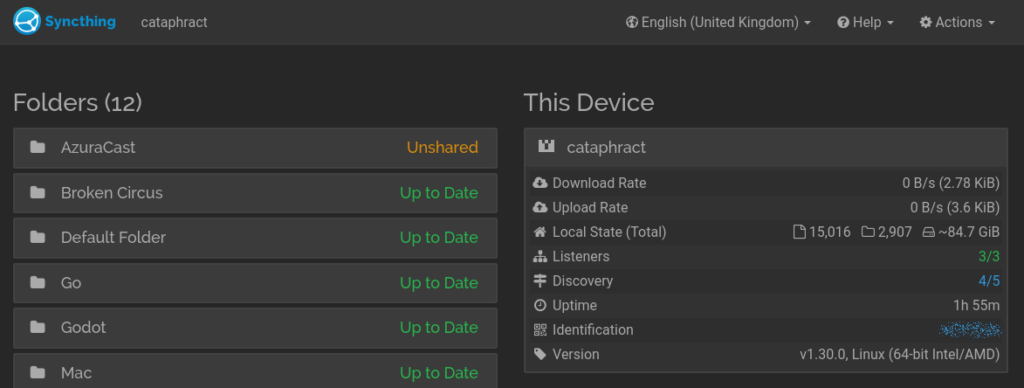
Screenshot of the Syncthing dashboard. On the left is a list of shared directories. On the right is an overview of the current system.

Great app, questionable name. (Like so many in the self-hosted world. And the world at large, let’s face it. I came across a full commercial program called Womp3D recently. That’s where we’re at.)

Syncthing is a tiny app that runs on all your devices and syncs data between them. That’s its purpose, and it satisfies that purpose better than most commercial software I’ve tried. In fact, it does exactly what I originally loved about Dropbox, before they decided my money wasn’t good enough.

It uses a transfer method that’s a bit like torrenting – so, for instance, if a folder exists on devices A and B, and device C wants it, it can download chunks from both A and B to speed the download up. And then if anything changes, it can send little chunks back to A and B.

I like it because it doesn’t pfaff around. There’s no feature bloat – in fact, I don’t think there have been any big new features since I first tried it circa 2014. It certainly looks the same as it did, anyhow. It’s just a simple tool that’s darned good at syncing files between devices – like, for instance, syncing my entire music library to my server which I can then use in…

Navidrome
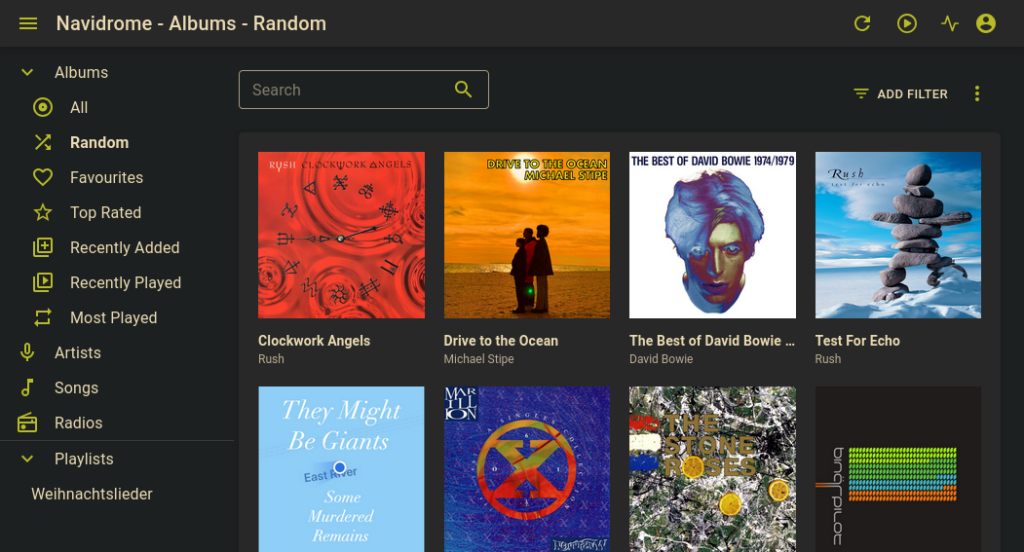
Screenshot of Navidrome albums list. On the left there are a series of categories to pick from, like Albums, Artists, or Songs. Subcategories include options like All, Random, Favourites, or Recently Played. In the centre is a grid of eight albums with large artwork. The page has a pleasing dark natural palette, with green highlights.

This one isn’t quite as tiny, but it still does one thing and one thing well.

Navidrome is best described, to the layperson, as a self-hosted Spotify. You can point it at your music, make playlists, rate (and I think even tag) your music, and it’ll even do things like artist radios and discovery queues for you. Quite why one would need to ‘discover’ their own music library escapes me, although I did see someone on Lemmy asking that very same question about their movie library… maybe I’m doing it wrong and everyone else is just pirating every movie and album on the planet for no reason? Who can truly say?

It’s also got nice themes, and recently it introduced a multi-library feature, which seems like it might be useful. I do like a good compartmentalise. Coupled with Syncthing, all I need to do is rip a CD to my computer, and it’ll show up in Navidrome within a few minutes, tags an’ all. Out of caution, I’ve done it as a one-way sync so that my computer is the ‘canonical’ source for my music library.

Cup
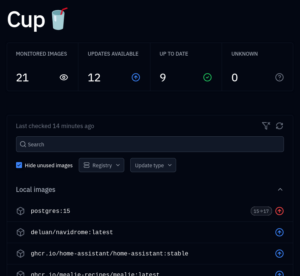
Screenshot of the Cup dashboard. (Nearly wrote 'cupboard'.) Along the top is an overview section, showing me how many monitored images there are, and which of those have available updates. Below that, there's a text list of images that require updates. Most have a little blue arrow next to them, which denotes a minor update is available. The top one has a red arrow, denoting a major update. It's got a sort of bluish grey colour scheme.

I used to run a little thing called Watchtower, which would periodically scan my Docker containers (for the laydividual: little boxes where apps live) to see if there were any updates available, and apply them automatically. Coming from a sysadmin background, that’s always a bit of a no-no. Ideally, you’d test your updates before blindly pushing them to a live server – to the extent that I had Watchtower’s features disabled on all but a couple of my services.

Anyway, Watchtower itself hasn’t been updated in years, and so I’ve instead taken a different approach. Cup presents a friendly little dashboard which just shows me what needs updating. Paired with Dockge, my chosen Docker container manager, I can then manually update if I want to; or I can use a script called Dockcheck to pull all the updates at once. I think that’s a better approach, and it means I have chance to read changelogs and see if anything’s been broken by the latest version. (This is why I have lots of little apps, and not one ‘everything’ app, you see?)

Glance
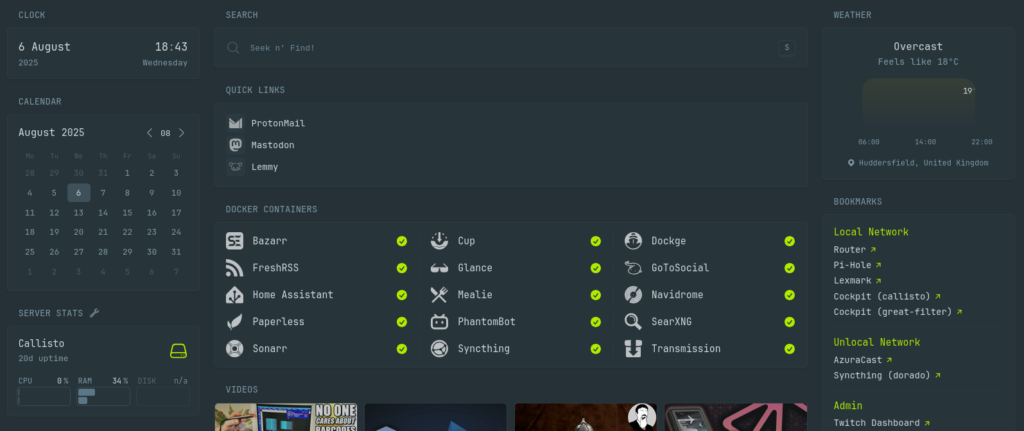
Screenshot of my Glance dashboard. In a three-column layout, it shows me the following items: the current date and time, a basic calendar, the stats of my server, a search bar, quick links to some websites, a grid list of my Docker containers, a feed of YouTube videos, the current weather, and a text list of bookmarks. The theme is similar to Navidrome's, but with a cooler overall feel.

Ah, the dashboard. Every self-hosted system needs a dashboard. After bouncing around a bunch of different dashboard implementations myself, I settled on Glance, which is easy to configure and does everything I need it to. I’ve actually got it set as my new tab page in Firefox, and it gives me instant access to all my self-hosted services as well as quick links to things like the admin page of this blog. It’s also got nice themes, which you can customise! One thing that’s missing: I’d like my Quick Links to be a horizontal list. (You can monkey around with the CSS so it’s probably fixable.)

GoToSocial

A photo of a sloth, hanging from a big tree branch. A baby sloth clings on. Both look quite content. The sky is blue and the tree is very green.

GoToSocial offers a lightweight ActivityPub server, similar to Mastodon but… well, lightweight. It’s not meant to have loads of users or loads of features, but it will do for my use case. …which is to have a small social network for close family. That’s kinda it, really! Whether it’ll take off is another matter, but the fact is there isn’t a great deal to see as yet. So, no screenshots. (Also, it’s secret, shhhh!)

Idiomakebelieve

I’ve mentioned before how, upon hearing a phrase I like the sound of, will try and work it into my vocabulary.

Continue reading “Idiomakebelieve”